

If you are experiencing persistent redness, swelling, and pain at the back of your heel, your first instinct might be to label it as Achilles Tendinitis. However, if traditional treatments for the tendon aren’t providing relief, you may be dealing with Retrocalcaneal Bursitis.
What is the Retrocalcaneal Bursa?
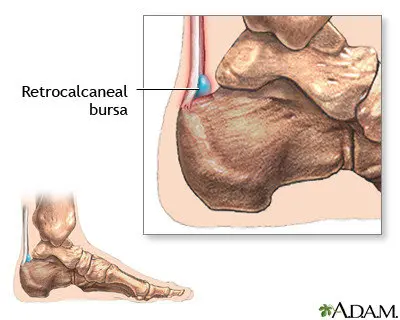
Think of a bursa as a small, fluid-filled cushion. The retrocalcaneal bursa sits specifically between your heel bone (calcaneus) and the Achilles tendon. Its job is to act as a lubricant, reducing friction as the tendon glides over the bone during movement.
When you contract your calf muscles, tension pulls through the Achilles tendon, causing it to rub against this bursa. Under normal conditions, this is seamless. However, repetitive friction, high-impact forces, or even tight-fitting shoes can cause the bursa to become irritated and inflamed
Spotting the Symptoms
The primary complaint is pain localized at the very back of the heel. You might notice the discomfort intensifies during specific activities.
- Tip-toeing or hopping: These movements put maximum load on the heel structures.
- Running uphill: This forces the ankle into a deep stretch, compressing the bursa.
- The “Heel Switch”: If you are accustomed to wearing high heels, switching suddenly to flat shoes can be a major trigger. In high heels, your Achilles tendon remains in a shortened state. Moving to flats forces an immediate, intense stretch that irritates both the tendon and the underlying bursa
Why Does It Develop?
Retrocalcaneal Bursitis rarely occurs in isolation; it is almost always the result of cumulative mechanical stress. For athletes, the most common culprit is overtraining—specifically a sudden, dramatic spike in running mileage that doesn’t allow the tissues time to adapt. This repetitive motion creates a “friction trap” where the Achilles tendon constantly grinds against the bursa.
Beyond activity levels, your physical anatomy and gear play a significant role. Some individuals are born with a Haglund’s Deformity, a naturally prominent bony bump on the back of the heel often nicknamed a “pump bump.” This protrusion significantly narrows the space for the bursa to move, making friction almost inevitable. When you pair this anatomy with ill-fitting footwear—specifically shoes with a rigid or restrictive “heel counter”—you create a localized pressure cooker effect. This pain may also be observable when
Therefore, a person with an excessively prominent posterosuperior aspect of the heel bone (Haglund deformity) may also have a higher predisposition to retrocalcaneal bursitis. In individuals with a Haglund’s Deformity or chronic inflammation, pain is most often reproduced when the ankle enters dorsiflexion—the movement of pulling your toes upward toward your shin.
Identifying the Root Cause: Bursa vs. Tendon
Distinguishing between bursitis and Achilles tendinitis requires a precise physical examination by a physician or physiotherapist because the symptoms overlap so closely. While both cause heel pain, the location of the tenderness is a major clue. In Insertional Achilles Tendinitis, the pain is usually felt exactly where the tendon anchors into the heel bone. In contrast, Retrocalcaneal Bursitis often feels deeper; the pain is typically most intense when you palpate the sides of the lower Achilles tendon, rather than the back of the tendon itself.
While a skilled physiotherapist can often determine the cause through touch and movement tests, we occasionally use ultrasound or MRI imaging. These tools allow us to visualize the fluid inside the bursa and the health of the tendon fibers, ensuring your treatment plan is targeting the correct structure from day one.
Path to Recovery: Managing the Inflammation
- Immediate Relief: Follow the R.I.C.E.R regime (Rest, Ice, Compression, Elevation, and Referral). Icing for 15 minutes can significantly dampen the acute inflammation.
- Footwear Adjustments: Temporarily switching to open-backed shoes or shoes with a slight heel can take the immediate pressure off the bursa.
- The Heel Cup Solution: Using a heel cup can elevate the inflamed area just enough to move it away from the shoe’s irritating heel counter. (Pro-tip: Always use cups in both shoes to maintain your pelvic alignment).
- Gradual Loading: We focus on progressive stretching and strengthening of the calf muscles to ensure they can handle impact without “yanking” on the bursa
At Core Concepts Singapore, we don’t just treat the inflammation; we resolve the mechanical issues causing it. Whether it is adjusting your running gait or managing a Haglund’s Deformity, our goal is to get you back on your feet without the fear of a flare-up.
