

Introduction to the Scapula Bone
We zero in on one of the most common presentations in a dysfunctional shoulder — scapula winging. The scapula also known commonly as the shoulder blade rests on the upper back ribs and is held up by multiple muscles collectively known as scapula stabilizers. Good movement of the scapula especially during shoulder movement is imperative in reducing any forms of shoulder injury.
How to identifying Scapula Winging

Scapula winging is commonly seen as a prominence of the inside of the scapula or shoulder blade usually upon movement of the arm. It can sometimes be visible at rest as well.
While its appearance can cause alarm, rest assured it is usually the result of a weak serratus anterior muscle that fails to anchor down the shoulder blade.
Scapula Winging and the Serratus Anterior Muscle
We must first remember that our muscles do not operate singularly or independently — rather, muscles work together, in tandem with others to achieve mobility and maintain body stability.
The serratus anterior is just one of the many scapula stabilizers and its role is to facilitate the upward rotation of the scapula. However, without the activation of the other scapula stabilizers like your lower trapezius , middle and upper trapezius, the scapula would also not be moving optimally. Hence, even though serratus anterior is the muscle we are zooming in on in this article, it’s imperative that these other muscles are not neglected as well.
When the Serratus Anterior system fails
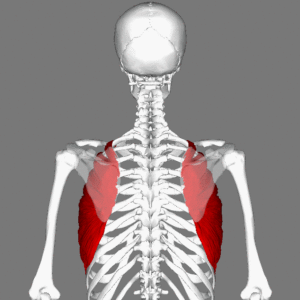
Imagine a large gear in a clock, unable to move — the surrounding gears will have to work even harder to keep the clock ticking.
That’s what happens when the serratus anterior muscle is weak. The tandem muscles, such as the upper trapezius or levator scapula muscle, work harder to compensate for the shortfall in powering the upward rotation, eventually causing tightness along the top of the shoulder, side of the neck or base of the skull.
Additionally, a weakened serratus anterior leads to lower stability for the scapula; the scapular then loses its anchor and protrudes like a wing.
What’s behind a weak Serratus Anterior Muscle?
There are several reasons why your serratus anterior (SA) is weak and here are three possible reasons:
- SA weakness can usually occur after a shoulder injury due to reduced proprioception after a shoulder injury and hence the poor motor control of surrounding musculature including the scapula stabilizer and the SA.
- A weak serratus anterior could be due to an over-activation of the upper trapezius muscles and levator scapular muscles, precipitated partly by poor posture. The serratus anterior loses its ability to be activated when these two muscles which also does the same function of upward rotation of the scapula, is overactive.
- Lastly, serratus anterior can be weakened when the long thoracic nerve supply is severed. However, this known to be an extremely rare occurrence.
Alleviating the pain
Like any muscle rehabilitation, treatment is usually centred on the aim of muscle strengthening.
Therefore, a series of progressive exercises are usually prescribed to overcome scapula winging, starting with a exercises such as a wall push-up and gradually progressing the exercise to more weight bearing versions such as into a four point kneeling position and finally in a two point plank position
Progressing the exercises are important, not just for strengthening the key muscles, but also for engaging the other tandem muscles. Particularly the upward rotator muscles, so that motor control (neuromuscular) established and/or re-trained.
Experiencing shoulder pain? Find out more about physiotherapy and how our physiotherapist at Core Concepts Singapore can help resolve your pain.
References
- Fiddian, N. J., & King, R. J. (1984). The winged scapula. Clinical orthopaedics and related research, 185, 228-236.
- Iceton, J. O. H. N., & Harris, W. R. (1987). Treatment of winged scapula by pectoralis major transfer. Bone & Joint Journal, 69(1), 108-110.
- Akgun, K., Aktas, I., & Terzi, Y. (2008). Winged scapula caused by a dorsal scapular nerve lesion: a case report. Archives of physical medicine and rehabilitation, 89(10), 2017-2020.
- Kuhn, J. E., Plancher, K. D., & Hawkins, R. J. (1995). Scapular winging. Journal of the American Academy of Orthopaedic Surgeons, 3(6), 319-325.
