
Do I need a Knee Support?
A knee guard can be particularly helpful during the early phase of managing knee injuries, such as Patellofemoral Pain Syndrome. It provides additional support and stability to the knee while helping you return to functional activities with less discomfort.
However, it is important not to rely on the knee guard long term. A knee guard should be seen as a temporary aid that supports your knee while the muscles around it are regaining strength through targeted physiotherapy exercises. The ultimate goal is to restore your knee’s natural stability so that your muscles—not the brace—provide the support you need.
At Core Concepts Physiotherapy, we view knee supports as a short-term bridge to recovery. Used appropriately, they allow you to stay active while you rebuild strength and control under professional guidance.
The best way to manage knee discomfort is to consult your physiotherapist for individualized exercises that strengthen the knee and address the underlying cause of pain. Knee guards should generally be weaned off as your strength improves, except in certain situations—such as **severe Osteoarthritis—where additional support may be required while a patient is awaiting procedures like a Total Knee Replacement.

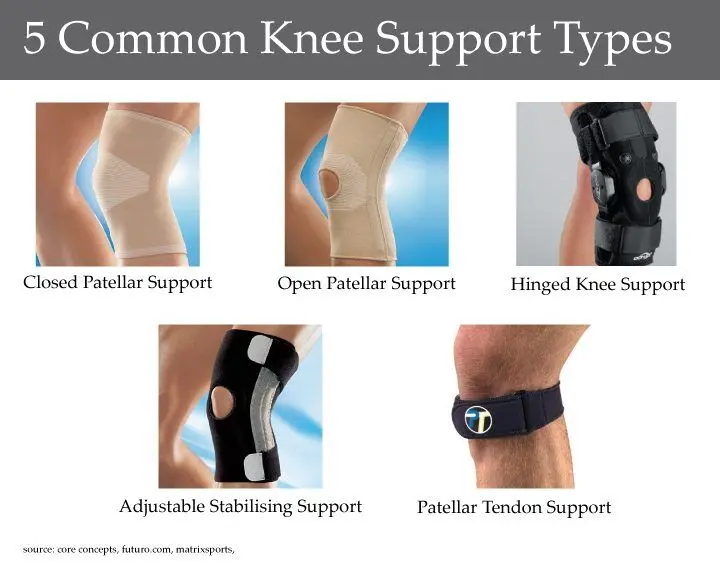
Selecting the right knee guard depends on many factors such as the activities you would like to refer to, the structures of the knee that require additional support, as well as the amount of support you need. Above are common knee guards used by our physiotherapy team.
1. Closed Patellar Support
Best for general compression and managing minor swelling during activities like jogging or brisk walking.
It covers the entire kneecap, we do not recommend this for daily use involving frequent stair-climbing or squatting. At angles greater than 45°, it can compress the patellar bone against the thigh bone, potentially increasing the risk of joint degeneration.
2. Open Patellar Knee Support
Similar to the closed version but features a cutout for the kneecap. This design relieves pressure on the patella, making it much more comfortable for daily wear, especially if you experience pain while squatting or taking the stairs.
3. Hinged Support
These are high-stability braces often prescribed by surgeons or sports physicians following ligament repairs (like ACL or MCL surgery).
These are typically worn during the day to protect these repaired ligaments in the early phase (6 weeks) after surgery.
4. Adjustable Stabilizing Knee Support
Ideal for athletes returning to sport after a ligament injury. It offers a “safety net” for those who are physically recovered but need additional psychological confidence and lateral stability during lateral movements.
These are typically worn only when the individual is doing high impact sports with the aim to wean it off completely over time.
5. Patellar Tendon Knee Support
A minimalist support designed specifically for “Jumper’s Knee” or pain localized directly on the tendon below the kneecap. By applying targeted pressure, it dissipates strain across the tendon to reduce acute pain during running or jumping.
It is important to remember that a knee brace is a powerful tool for temporary relief and stability. Our goal is to help you to transition back to the functional activities you enjoy eventually without the use of an external brace.
Find out more about physiotherapy for knee pain relief and how Core Concepts Singapore can help resolve your pain.
